
Which J.League team should you watch? A guide for visitors
How to choose a J1 club to watch in Japan, by the city you're staying in, the kind of matchday you want, and the history behind the club.
“Which team should I support?” comes up every season on English-language J.League forums, usually from someone who has just booked flights to Japan and noticed there’s a match on. The honest answer is that there’s no wrong choice. Japanese crowds are friendly, away fans are welcome, and nobody minds if you’re a neutral who bought a scarf at the gate.
What does make a difference is picking the right match for your trip. Most visitors decide in the same order: where they’ll be, what kind of afternoon or evening they want, and then whether a club’s story grabs them.
Start with where you’ll be
Twenty clubs play in J1, so a normal round means ten matches spread across the country, mostly on Saturday and Sunday. Before you fall for a club, check which ones are at home near your hotel on the days you’re free.
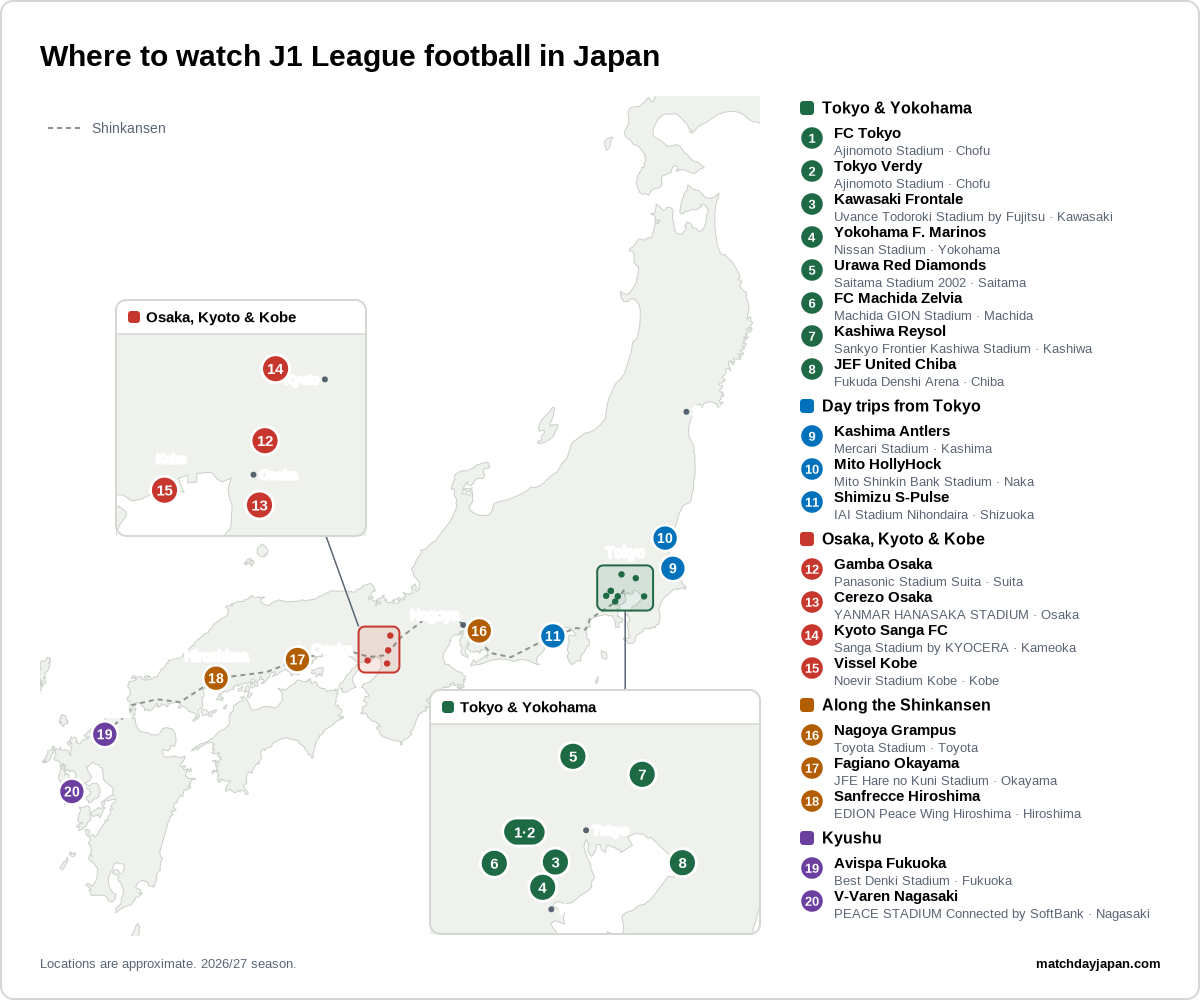 Tap the map for the full-size version on our J1 clubs by city page.
Staying in Tokyo? You have eight clubs within about an hour, so you’ll almost always find a match. FC Tokyo and Tokyo Verdy share a stadium 20 minutes from Shinjuku; Kawasaki Frontale and Yokohama F. Marinos are south of the city; Urawa Red Diamonds, Kashiwa Reysol and JEF United Chiba are north and east. See where to stay in Tokyo for which base suits which ground.
See hotels in Shinjuku on Klook
Staying in Osaka, Kyoto or Kobe? Gamba Osaka, Cerezo Osaka, Kyoto Sanga FC and Vissel Kobe are all within an hour of Umeda, and on a lucky weekend you can see two of them. Our Kansai guide covers the bases.
Travelling by Shinkansen? Nagoya, Okayama and Hiroshima all have stadiums you can fit in between trains. Okayama’s is a walk from the station.
In Kyushu? Avispa Fukuoka play next to Fukuoka Airport, and V-Varen Nagasaki play in a new stadium a short walk from Nagasaki Station.
Then decide what kind of matchday you want
A big, loud crowd
If noise is what you’re after, go to Urawa Red Diamonds. Saitama Stadium 2002 was built for the World Cup, and its home end is known across Asia for the noise it makes. Yokohama F. Marinos play at Nissan Stadium, the largest in Japan and the venue of the 2002 World Cup final, a walk from a Shinkansen station.
Close to the pitch
Smaller grounds can be more fun than big bowls. At Kashiwa Reysol, steep stands sit right against the touchline and you can hear the players shouting. At V-Varen Nagasaki, the front row is about 5 m from the pitch and every seat is under the roof.
A match and a day out
Some stadiums are worth it for what’s around them. Kyoto Sanga FC play next to Kameoka Station, where the Hozugawa river boats and the Sagano scenic train start, so you can spend the morning heading towards Arashiyama and the evening at the match. Sanfrecce Hiroshima play in the city centre, a short walk from the Peace Memorial Park. Vissel Kobe are 10 minutes by subway from central Kobe, with its harbour, Chinatown and beef restaurants.
A view
On a clear day, you can see Mt Fuji from the stands at Shimizu S-Pulse. You’ll need the shuttle bus to get up the hill, so check its times before you go.
An easy first match
If you’ve never been to a game in Japan and want as few surprises as possible, FC Tokyo is a good start. When we went to Ajinomoto Stadium, the signs from Tobitakyu Station were in English all the way, the walk took under 10 minutes, and the food park outside took foreign cards and Alipay. The one catch is that not every Keio Line train stops at Tobitakyu, so check before you board.
Or pick a club for its story
Every club has fans who will tell you theirs is the one that matters. A few histories stand out:
- Kashima Antlers have won more J1 titles than any other club, despite coming from a small coastal town in Ibaraki.
- Tokyo Verdy won the first two J.League titles, in 1993 and 1994, as Verdy Kawasaki, and came back to J1 in 2024 after 15 years away.
- Urawa Red Diamonds have won the AFC Champions League three times, more than any other club in Asia. Gamba Osaka (2008) and Kashima (2018) have won it too.
- Mito HollyHock are playing their first ever J1 season in 2026/27, and moved to a bigger stadium for it. Every home game still feels like an occasion.
Matches to look out for
Local derbies are the hottest tickets of the season, so if your dates line up with one, book early.
- The Tokyo derby: FC Tokyo v Tokyo Verdy, played at the stadium they share
- The Osaka derby: Gamba Osaka v Cerezo Osaka
- The Tamagawa Clasico: Kawasaki Frontale v FC Tokyo, named after the river between them
- The Kanagawa derby: Kawasaki Frontale v Yokohama F. Marinos
Smaller grounds sell out faster than big ones, too. Kashiwa and Hiroshima are worth booking as soon as tickets go on sale, while a big stadium like Nissan usually has more room.
Choosing who to support
You don’t need a team before you go, and you won’t be asked for one. If you want to join in, sit in a home area, wear the home colours or something neutral, and clap along with the songs. The only real rule is not to wear the visiting team’s shirt in the home sections, or the home shirt in the away end.
Plenty of visitors come home with a scarf and keep following the club afterwards. Pick the match that fits your trip, and see who you end up cheering for.
Next steps
- Find your club on the J1 clubs by city page for the route, where to stay and what to do nearby
- Buy tickets from an official seller
- Read what to expect at your first J.League match